
FPGA vs microcontroller vs ASIC: which fits your product?
Hephaestus Technology6 min read
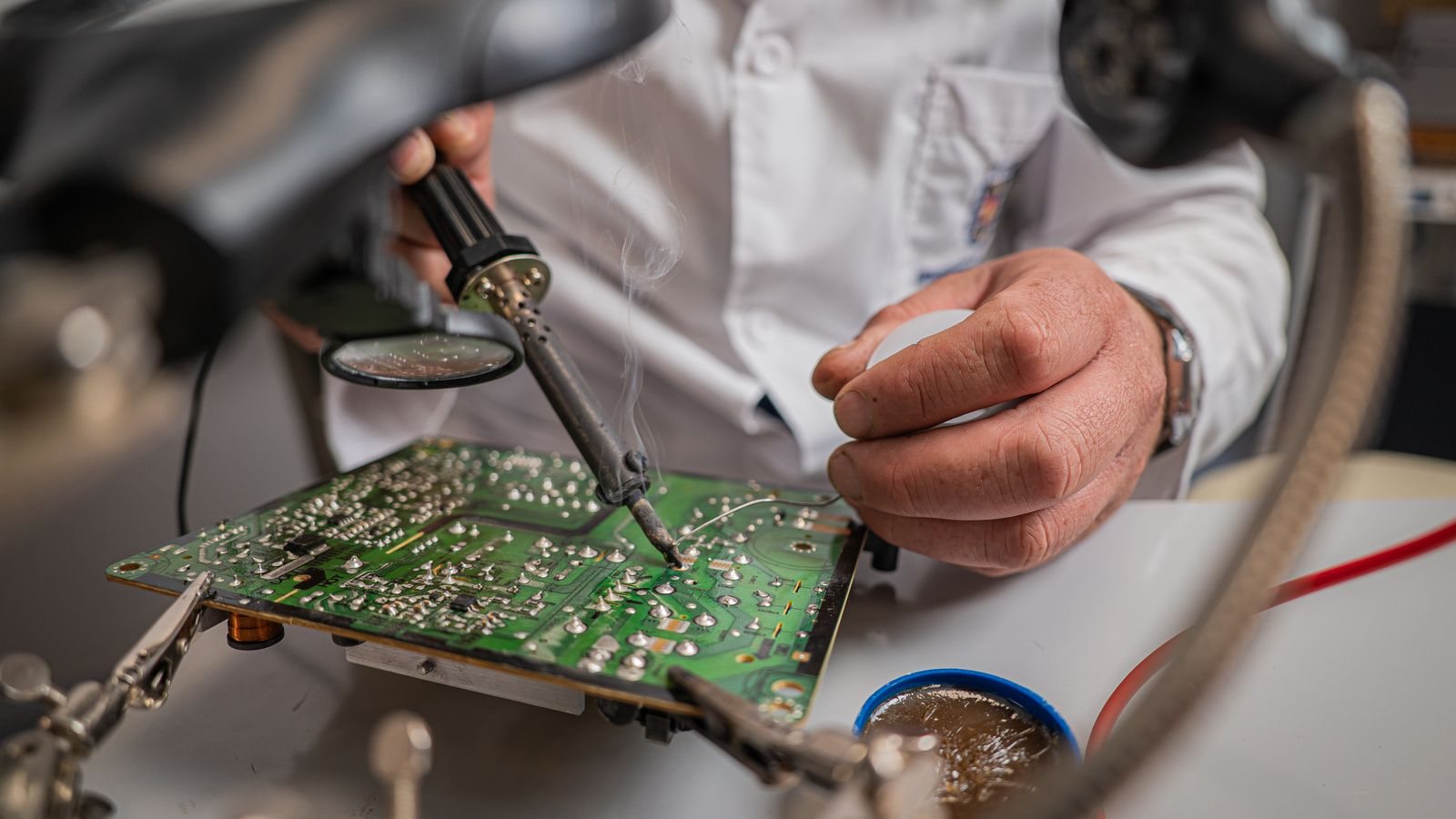
For most new products, start with a microcontroller: it is the cheapest, lowest-power and fastest way to ship, and modern parts handle sensing, connectivity and even small AI models. Choose an FPGA when you need hardware-level parallelism, precise timing or custom interfaces that a microcontroller cannot deliver, or when the design is still changing. Consider an ASIC only when volumes are high enough, and the design stable enough, to justify a large one-off investment in a custom chip.
Key takeaways
- A microcontroller is the default for connected products, sensors and control tasks.
- An FPGA is reconfigurable hardware: use it for parallel signal processing, custom interfaces or tight timing, and as a way to prototype logic that may later become an ASIC.
- An ASIC has the lowest unit cost and power at scale but needs high volumes and a frozen design to pay back its development cost.
- Many products combine them, for example a microcontroller running the system with a small FPGA handling one fast interface.
- In Ireland and the EU, shared-wafer prototyping and the national chips competence centre lower the barrier to trying custom silicon.
What is the difference between an FPGA, a microcontroller and an ASIC?
A microcontroller (MCU) is a small computer on a single chip: a processor core, memory and peripherals that run software you write. An FPGA (field-programmable gate array) is a chip full of configurable logic blocks that you wire together with a hardware description language, so the "program" becomes a circuit. An ASIC (application-specific integrated circuit) is a chip designed and manufactured for one purpose, with the circuit fixed at the factory.
The practical difference is where the flexibility sits. An MCU is flexible in software, an FPGA is flexible in hardware, and an ASIC is not flexible at all after manufacture, which is exactly why it can be smaller, cheaper per unit and more efficient.
FPGA vs microcontroller: how do they compare?
The table summarises the trade-offs founders usually weigh. These are general characteristics, and specific parts vary widely.
| Factor | Microcontroller | FPGA | ASIC |
|---|---|---|---|
| How you program it | Software (C, C++, Rust) | Hardware description (VHDL, Verilog) | Designed once, fixed at fabrication |
| Parallelism | Limited, sequential code | Massive, true hardware parallelism | Whatever you design |
| Power | Very low, with deep sleep modes | Higher in general, though low-power families exist | Lowest for a given task |
| Unit cost | Low | Moderate to high | Lowest at high volume |
| Upfront cost | Low | Moderate (tools, specialist engineers) | High (design, verification, masks) |
| Change after launch | Firmware update | Reconfigure the bitstream | New chip required |
| Time to first product | Shortest | Medium | Longest |
| Typical use | Sensors, control, IoT, small AI models | Video, radio, motor control, custom I/O, prototyping chips | High-volume, power or size-critical products |
When is a microcontroller the right choice?
A microcontroller is right when the job is sensing, control, communication or modest data processing, which covers most connected products. Modern MCUs also integrate radios and signal-processing features. Espressif's ESP32-S3, for example, combines a dual-core processor running at up to 240 MHz with 2.4 GHz Wi-Fi, Bluetooth LE and vector instructions that speed up neural network and signal processing workloads.
Higher-end cores close more of the gap with dedicated hardware. Arm states that its Cortex-M55 delivers up to 15 times the machine learning performance and up to 5 times the signal processing performance of existing Cortex-M processors, and that pairing it with the Ethos-U55 microNPU gives a 480 times uplift in ML performance over existing Cortex-M based systems. These are vendor figures without a published benchmark, but they explain why many tasks that once needed an FPGA now fit on an MCU. Our explainer on edge AI on embedded devices covers what that makes possible.
When should you use an FPGA instead?
Use an FPGA when the work must happen in parallel, in hardware, with timing a processor cannot guarantee. Typical cases are processing many sensor or video channels at once, implementing a non-standard or very fast interface, software-defined radio, and motor or power control loops that need deterministic microsecond responses.
FPGAs are not always power-hungry. Lattice's iCE40 UltraPlus family lists static current as low as 75 µA, up to 5,280 logic look-up tables and a 2.15 x 2.50 mm package, and Lattice describes key-phrase detection demos consuming less than 1 mW of average power. Small FPGAs like this often sit beside an MCU to handle one demanding task.
The trade-off is engineering: FPGA design needs hardware description skills and verification work that most software teams do not have, and that cost often outweighs the chip price.
When does an ASIC make sense?
An ASIC makes sense when three conditions hold: volumes are high, the design is stable, and power, size or unit cost matter enough to justify the upfront investment. Because the circuit is fixed, a bug found after fabrication means a new chip.
A common path is to prove the logic on an FPGA first, then convert it. Prototyping silicon no longer requires a full production run. Europractice offers multi-project wafer runs, where several designs share one wafer to reduce prototyping cost, across foundries including TSMC, GlobalFoundries, IHP and X-FAB. Its prototypes are usually delivered unpackaged and untested, with packaging available as an add-on.
In Ireland, the national chips competence centre I-C3, launched in February 2026 and coordinated by Tyndall National Institute, gives startups and SMEs access to funding pathways, training, design tools and pilot line facilities, and connects them to European pilot lines. Our guide to hardware prototyping in Ireland lists other facilities.
How do you decide for your product?
Answer these questions in order and stop at the first "yes".
- Can a microcontroller do the job within your power and timing budget? Prototype it on a development kit. If yes, use an MCU.
- Is there one task an MCU cannot handle? Add a small FPGA or a dedicated peripheral chip for that task alone.
- Does the whole design need hardware parallelism or reconfigurable logic? Use an FPGA, possibly an FPGA with built-in processor cores.
- Will volumes and a frozen design justify custom silicon? Plan an ASIC, using the FPGA version as the reference.
Write down the reason for each decision. Investors and future engineers will ask why the product uses the chip it does.
Frequently asked questions
Is an FPGA faster than a microcontroller?
For parallel tasks, usually yes, because an FPGA runs many operations at once in hardware. For general sequential code, a fast microcontroller may be simpler and fast enough. The right comparison is whether each option meets your specific timing and power needs.
Can I run machine learning on a microcontroller instead of an FPGA?
Often yes. Many microcontrollers now include vector instructions or neural processing units for small models such as keyword spotting or anomaly detection. FPGAs remain useful for higher-throughput or custom model pipelines.
How much does an ASIC cost to develop?
It varies too widely to give a reliable figure, depending on process node, complexity, verification and volume. Shared multi-project wafer services such as Europractice reduce prototyping cost by spreading mask and wafer costs across several designs. Get quotes for your specific design before deciding.
Should a startup use an FPGA in its first product?
Only if the product genuinely needs hardware parallelism, precise timing or a custom interface. FPGAs add specialist engineering cost, so most startups start with a microcontroller and add an FPGA later if a specific task requires it.
What is a microNPU?
A microNPU is a small neural processing unit designed to sit beside a microcontroller core and speed up machine learning inference. Arm's Ethos-U55 is one example, designed for area-constrained embedded and IoT devices.
Weighing up MCU, FPGA or custom silicon for a new device? Book a free 30-minute call with our hardware team.
Cover photo by Maikol Herrera on Pexels.